The Austin City Council is scheduled May 23 for a second reading on a proposed ordinance to form an Electric Utility Board to oversee the business of Austin Energy.
Under the proposed ordinance, a subcommittee of Council Members would nominate members for Council approval to the board based on expertise in areas such as the electric utility industry, rate making, engineering, finance, community service or activism and environmental science and policy. The Council could not appoint one of its own members to the board. Under the proposed ordinance, all board actions would require Council review and adoption. Under the proposal, the electric utility would be managed and operated by the general manager, who could be appointed by, would report to, and could be removed by the City Manager.
The proposed ordinance is available for viewing or downloading:
http://www.scribd.com/doc/141434332/Austin-Energy-Governance-Ordinance-May-9-2013-Draft
Tuesday, May 14, 2013

Friday, May 10, 2013
New Downtown Library Site Powered Up
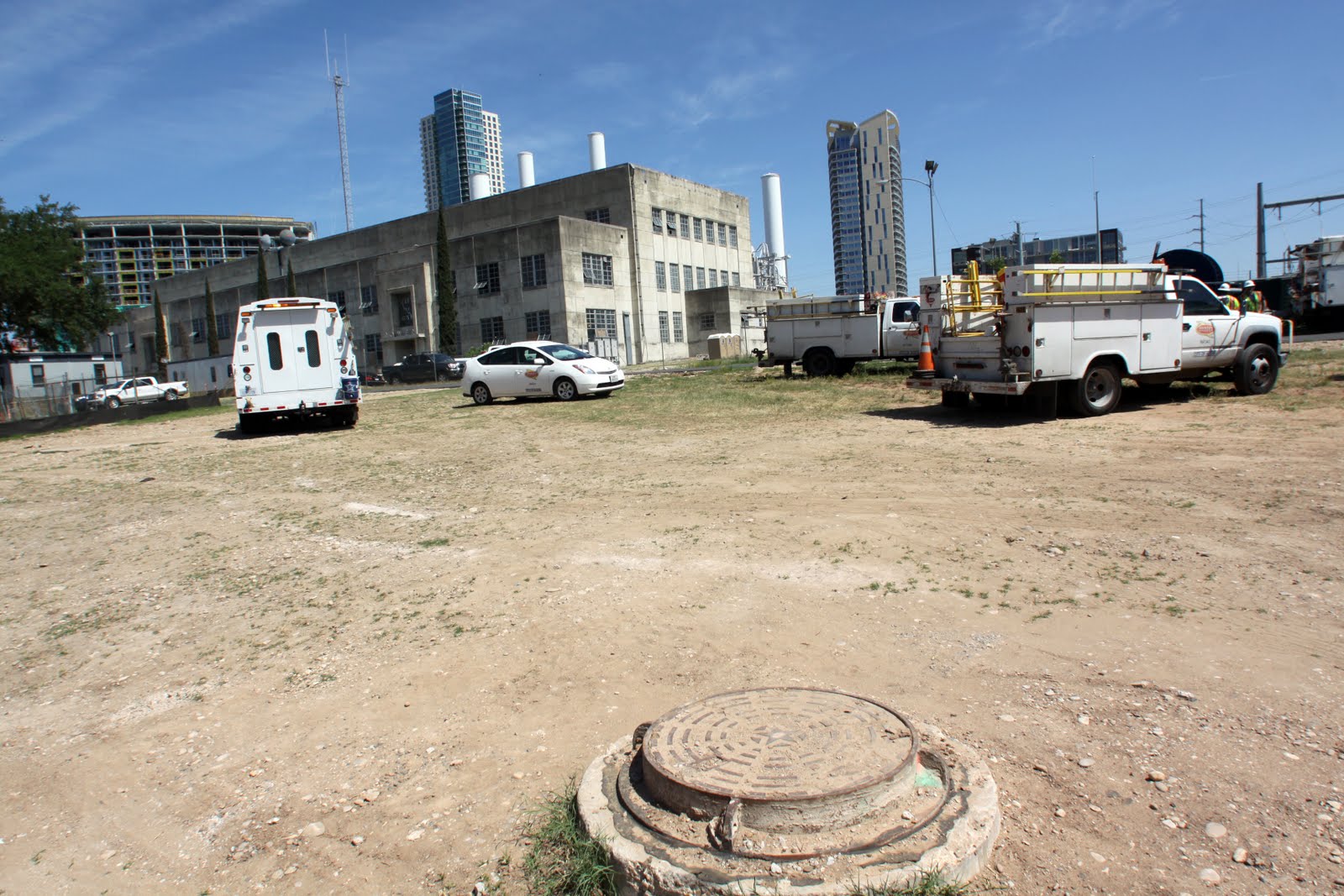
Austin Energy linemen recently rerouted five
underground power lines and installed 5,000 linear feet of new cable on
the site of the New Central Library near the former Seaholm Power Plant.
The linemen completed the work in time to ready the
site for a May 30th groundbreaking ceremony for construction of the $90
million, 198,000-square-foot library and also to provide electricity to
the former Seaholm Intake Facility across the street, which will be
reused for a public purpose on the shores of Lady Bird Lake.
 |
| The New Central Library site is between the former Seaholm Power Plant and former Green Water Treatment Plant, scheduled for redevelopment. |
 | ||||||
| Austin Energy linemen use reels to install new cable as well as take out old cable that is being replaced. The reels can each hold 1,200 linear feet of cable. |
 |
| Austin Energy linemen pull out old cable from underground that will no longer be used, because new lines had to be reconfigured as part of the New Central Library site construction. |
 |
| Crew members worked in underground vaults to install equipment necessary to power-up the new library construction site. Much of the downtown power grid is underground to increase reliability and aesthetics. |
 |
| Crew members prepare to begin installing power lines in an underground vault. |
 |
| The linemen rerouted five power circuits underground to ready the site for construction of the New Central Library. |
Thursday, April 25, 2013
Austin Area Science Fair Students Advance to International Competition
Six science projects involving 9 students from Austin area schools and one from Houston (member of an Austin team) have advanced to the Intel International Science and Engineering Fair to be held May 12-17 in Phoenix, Arizona. This is the annual super bowl of science competition involving some 1,500 of the brightest students from around the world (http://www.societyforscience.org/isef/).
Meet the students and their projects:


Summary: Cystic fibrosis is a deadly genetic disease. Current medicine can determine if a patient has the gene but cannot accurately predict if the patient will actually develop the disease. These students created a new mathematical formula for evaluating genes that enables scientists to more accurately predict the probability that a patient who carries the cystic fibrosis gene will actually get the disease.


The students below earned their spots at the International fair by advancing from the Austin Energy Regional Science Fair and the ExxonMobil Texas Science and Engineering Fair (http://emtsef.utsa.edu/). Congratulations to these excellent students and their schools for this tremendous achievement.
Meet the students and their projects:

Casey Hicks and Leah Powers (Seniors) – Vista Ridge High School, Cedar Park
Application of T4 Bacteriophages in Real-Life
Summary: Many disease-causing bacteria have become antibiotic resistant, meaning that traditional anti-biotics such as penicillin are less effective. These students demonstrate the use of a bacteria’s natural enemy (a virus) to kill the bacteria instead of antibiotic drugs.

Alex Crisara (Senior) and Alexander Jahan Rabii (Junior) – Anderson High School, Austin
Efficient Algae-Based Life Support for Long Duration Spaceflight
Summary: Current water and oxygen storage techniques play a huge role in limiting the ability to stay in space for long periods because of their weight and limiting supplies. These students developed a system using algae (comparatively inexpensive) to extend astronauts' time in space by recycling water (for reuse) and producing oxygen in the process.

Jessica Wang, Lily Xu (Juniors- Liberal Arts and Science Academy, Austin) and
Susan Xu (Junior- Kingwood High, Houston not pictured)
The Connectivity of Sequential Formal Languages with Applications to Genomic Sequences

Vanna Hovanky (Junior) – Bowie High School, Austin
Bacterial β-galactosidase Enzyme-Prodrug Therapy: A New Approach Against Colon Cancer
Summary: Vanna developed a way to transform harmless bacteria (normally already found in the colon) into a colon cancer-fighting mechanism. The bacteria basically converts a nontoxic drug into a cancer-fighting drug within the colon itself.

Advaith Anand (Junior), Lasa High School, Austin
Natural Gas Separation Using Thermally Rearranged Polymers - Characterizing Morphological Changes of HAB-6FDA Polyimide Structures
Summary: When natural gas comes out of the ground, it is not in a readily usable form. It must be separated from all of the other liquids and gases (including CO2) before it can be used. This is currently an expensive and relatively inefficient process. Advaith proposes the use of a new material and inventive process that will separate the gas in a more cost effective and efficient manner, thereby reducing production costs and increasing efficiency.

London Bolsius (Sophmore) – Round Rock High School, Round Rock
3D Scanner
Summary: 3D scanners can scan real-world objects (such as a machine part) and import that object into a computer as a 3D object that can then be manipulated on a computer. 3D scanners currently exist but are prohibitively expensive. This student has created a highly accurate 3D scanner that uses “off the shelf” components and software for around $300.
Tuesday, April 23, 2013
Austin Energy To Offer New Thermostat Program
Austin Energy is launching a new voluntary energy management program for residential customers who use WiFi thermostats to control their cooling and heating systems. Qualifying thermostats for the program are Nest, ecobee and Filtrete, which are available through local home improvement stores or through heating and air conditioning companies. Once a qualifying thermostat has been purchased and installed, a customer can enroll in the Austin Energy Power Partner Program through the respective web site of their thermostat company. Austin Energy provides an $85 rebate for each qualifying installed thermostat.
For the incentive, customers agree to allow Austin Energy to access their thermostats over the internet and briefly modify temperature settings incrementally by up to four degrees over a maximum of three hours (but generally not more than two hours) when demand for electricity is the highest in Austin and Texas. These energy management efforts have been used an average of about 15 days over the summer between 4 and 6 p.m. and only on weekdays.
WiFi thermostats can help customers reduce their annual air conditioning and electric heating costs by up to 20 percent because they allow the customer to manage the comfort of their home or apartment remotely via smart phones or computers. For additional information call Austin Energy at 512-482-5346.
(This thermostat program has been in the pilot stage for several months and is scheduled for City Council approval this Thursday, April 25.)
(This thermostat program has been in the pilot stage for several months and is scheduled for City Council approval this Thursday, April 25.)
Monday, December 17, 2012
Water Treatment Plant #4 Substation To Be Energized
Austin Energy is working to energize by the end of January the Bullick Hollow Substation to help power the construction and later the operation of the Austin Water Utility's Water Treatment Plant #4 under development near RM 620 and Bullick Hollow Road.
The substation has two large transformers dedicated solely for use by the treatment plant, and it can be expanded with two additional transformers as the needs of the plant grow. Austin Water is among Austin Energy's largest electric customers because of the Water Utility's need to treat and provide water to an ever-growing metro area.
Photos from the substation construction site:


The substation has two large transformers dedicated solely for use by the treatment plant, and it can be expanded with two additional transformers as the needs of the plant grow. Austin Water is among Austin Energy's largest electric customers because of the Water Utility's need to treat and provide water to an ever-growing metro area.
Photos from the substation construction site:

138 kilovolt (kV) Bullick Hollow Substation for Austin's Water Treatment Plant (WTP) #4

Austin Energy's 50 Mega Volt Amperes (MVA) Station Power Transformer that will be used to step down the 138kV to 12.47kV distribution level voltage to feed WTP#4

Austin Energy's 50MVA Station Power Transformer and the 12.47kV Power Control Room

Austin Energy staff perform a monthly Field Safety Audit

Austin Energy's Substation Construction workers prepare conduit for installation.

Final tightening of conduit feeding the Power Control Room

Installing the conduit on the Power Control Room

Installing conduit on the Power Transformer

Austin Energy's Substation Maintenance personnel verifying nitrogen pressure on the Power Transformer

Austin Energy's Substation Maintenance Power Transformer hot oil processing and vacuum filling

View of the Power Transformer and Power Control Room with the overhead distribution lines that will feed the WTP#4

WTP#4 Construction
Thursday, November 8, 2012
Power Plants Weatherized for Winter Temperatures
Austin Energy power plant personnel are busy gearing up for winter weather. Insulation is being inspected and replaced or added as needed around sensitive equipment and various pipe lines that manage plant functions or deliver water for the electricity-making process.
All generation plants in Texas reviewed their winterizing protocols after February 2011, when freezing temperatures over a six-day period resulted in the loss of more than 80 generating units that either could not start or could not operate at capacity due to prolonged freezing temperatures. That led to six hours of rotating blackouts throughout Texas until sufficient generation was available.
Power plants in the south are not built with as much or the same types of insulation as plants in northern areas because prolonged periods of freezing temperatures are not common during winter months in the southern states and excess insulation can hamper the efficiency of plants operating during long hot summers.
Austin Energy plant personnel are also inspecting instrumentation that could be affected by freezing temperatures. This includes checking portable heaters located strategically to protect sensitive instrumentation. These winter checks are expected to be completed by the end of November. Austin Energy has two power plants located in Austin: the Decker Creek Power Station and the Sand Hill Energy Center. Both plants operate on natural gas.


All generation plants in Texas reviewed their winterizing protocols after February 2011, when freezing temperatures over a six-day period resulted in the loss of more than 80 generating units that either could not start or could not operate at capacity due to prolonged freezing temperatures. That led to six hours of rotating blackouts throughout Texas until sufficient generation was available.
Power plants in the south are not built with as much or the same types of insulation as plants in northern areas because prolonged periods of freezing temperatures are not common during winter months in the southern states and excess insulation can hamper the efficiency of plants operating during long hot summers.
Austin Energy plant personnel are also inspecting instrumentation that could be affected by freezing temperatures. This includes checking portable heaters located strategically to protect sensitive instrumentation. These winter checks are expected to be completed by the end of November. Austin Energy has two power plants located in Austin: the Decker Creek Power Station and the Sand Hill Energy Center. Both plants operate on natural gas.

A Sand Hill Energy Center contractor prepares to install the next piece of insulation which resembles an oversized piece of chalk.

The insulation is installed on various pipe lines that mainly carry water used during the
power generating process.

The insulation fits snugly around the piping and is secured with metal wire.

In other areas of the plant, some of the steam pipes can reach 1,100 degrees Fahrenheit

Once the insulation
has been installed, a metal cover is wrapped around it to protect it
from inclement weather. The contractor has to measure and cut each piece
of metal to fit the various size pipes at the plant.


Friday, November 2, 2012
Austin Energy Employee Held Real Life Role in Rescue Depicted in "ARGO"
Current Austin Energy employee Thom McInnis played a key
role in the rescue of the six American diplomats in 1979 during the
Iranian Revolution depicted in the movie “ARGO” currently playing in theaters.
McInnis was a young G.I., then stationed in Germany, who had graduated from high school in Tehran a year earlier when Americans were evacuating for their own safety. Rear Admiral S.H. Packer with European Command Headquarters personally requested Thom’s assistance with the rescue of the diplomats. Thom was familiar with the streets of Tehran and was fluent in Farsi, the most commonly spoken language in Iran. He helped track the movements of the Americans as they hid from house to house, and he spoke by phone with Iranian sympathizers, hiding them as they eventually made their way over seven days to hide at the Canadian ambassador’s home.
Below are the appreciation letter sent to Thom McInnis by Rear Admiral Packer for his part in the rescue; a photo of Thom in Iran; and his personal account of the rescue.

Thom makes Ash soup -- a barley soup -- with some women from his neighborhood in Iran.

The following is Thom's personal account of his role in the rescue:
"Recently the movie ARGO was released. Many of my friends know how excited I was to see the movie ARGO. Besides the fact that I lived in Tehran prior to and during the revolution, there is another side to my involvement in the Canadian Caper/ARGO story that I have not shared with many online. This is part of my story that not many people know about.
I just recently found out that this information became unclassified. Before I shared it, I needed to
dig through my box of old papers and find a very special letter of appreciation to me from Admiral Packard for my service during the Embassy take over in Iran. With the movie ARGO just released telling about the phenomenal rescue of the 6 American diplomats during the Iranian Revolution, I am now sharing this part of my story with my friends.
At the age of 17, I was living alone half a world away from my family. By the end of summer 1978 my parents and siblings rotated back to the USA and I stayed behind living largely on my own renting the basement maid’s quarters of a friend’s house until I could to graduate midyear with my classmates. In October the family I was staying with was evacuated out by their company October. From then on I played musical chairs staying where I could until Pan Am began evacuating all non-essential personnel from Iran before Christmas of 78.
Like many Tehran American School students, life in Tehran was a wonderfully magic time. We did not have all the creature comforts of our peers in the USA. But we were having experiences that many of them would never touch. Our school community was tight, our classmates were family. Our sporting events were times of festivity and celebration that I have not seen since. Unfortunately for those of us that were there up to the end, this was suddenly ripped from us. A former TAS alumni quoted a passage from a book on our Tehran American School web page "You get a strange feeling when you're about to leave a place, I told him, like you'll not only miss the people you love but you'll miss the person you are now at this time and this place, because you'll never be this way ever again." So it was to be for all of us ripped from this time and place so abruptly.
Late 1978, the beautiful friendly country and people began to change. Where once we could walk the streets and were treated friendly, Iranians began to avoid us less they be found guilty by association. Fear began to spread as a cancer. Mass hysteria and the pack mentality of the mobs began as the mullahs began to stir up and foment discontent from the minarets and mosques of Iran. Towards the end of 1978 the mobs reached Tehran. The house we lived in in north Tehran was pipe bombed days after my family left for the US. Before he left Iran, my father and I were shot at on our rooftop one night. The mobs kept shooting up the neighborhood of the security officer I stayed with right before I left for the last time. I used to run security roadblocks in taxis to get home from my part time job at Pan Am before curfew. One time we did not make it and I spent a couple of hours with an unhappy taxi driver at the gendarmerie station until our stories were checked out and he was given a pass to continue to drive me home. After that I stayed the night at the airport and ran home in the morning, bathed and ran off to classes at TAS (often writing my own tardy notes as I was on my
own).
I remember a scared military conscript shoving a M16 in my stomach when I surprised him (he was sleeping on his post at the gas station where I purchased kerosene for the heater at my room). I remember the tanks on the streets...the roving military and revolutionary patrols...the smell of burning tires (to offset the effects of tear gas)...I remember the moment the lights went out when Martial Law Curfew went into effect is when all the fires started in the streets (we could see them light up the city like Christmas lights as our house was on the north side of town by the foothills to the mountains)....I remember walking into school one morning to be greeted by the counselor and informed that the school was closing and that I was now a graduate of TAS. I remember evacuating many of my schoolmates and their families those last days when I worked at the airport...I remember fathers throwing their children over the heads of the crowds at the airport in a bid to get closer to the front of the line for those limited seats out of the country.
I remember my own last bumpy journey to the airport under a bunch of carpets and rags in the back of a van. I remember flying into the sunset on my last flight out of Tehran...a feeling of emptiness and loss...I remember not having my bearings when I returned to the US...and gratefully found those bearing by joining the Army 2 months after returning...I was not ready to re-enter the NORMAL life of my fellow 17 and 18 year old peers after roller coaster ride I just experienced. (A job at McDonalds was not to be my future while I waited to get into college) I left Iran right before Christmas of 78. I really did not have any idea what I wanted to do. My plans were to keep working with PAN AM and save money for college. Returning to the USA, I joined the Army in January of 1979.
After basic and advanced communications training I was assigned to the 2d Support Command, Stuttgart, Germany. While there I ran into a friend of my parents in church. He was a USAF Staff Sergeant assigned to the European Command Center.
When the Embassy was seized, Admiral Packard was having a fit in the SCIF (a signal proof room) with Washington because he could not get a Farsi linguist for several weeks. This Staff Sergeant told him that he knew me from Iran and that I spoke Farsi. According to my friend, the Admiral was "and so what." This SSgt told him, "Sir, you don't understand; he joined the army and is here in Stuttgart." That Saturday afternoon my very shaken 1st lieutenant called me down to the Battalion HQ and trembling told me that he did not know what I had done. but I was to (be) packed and ready to go in 20 minutes when the admiral's staff car was to pick me up.
I then spent the 11-04-79 through 11-11-79 at the European Command Headquarters sitting on the floor of the admiral's command center manning two phones tracking the movements of the group led by Robert Anders. This was done by fielding calls from Iranians still friendly to the American Government. As the calls would come in, they would be directed to me. I would speak with the Iranians and using my knowledge of the streets of Tehran from having used the Bus system, I plotted their day to day, house to house progress on a large map of Tehran as they made their way ultimately to the safety of the home of a Canadian diplomat on 11-10-79.
Unlike in the movie, the Anders group were actually divided up and hidden in a couple of houses; not just the Canadian Ambassador's residence and it took them 7 days moving house to house to get there. On 11-11-79 I was relieved of my special duties as "Defense Language Institute" trained Farsi linguist arrived on site. From that point on I was used to plot information on the Tehran map and assisted my friend, the USAF Communications Sergeant in the SCIF.
You can see how the timeline from the letter of Admiral Packard corresponds to the timeline given in the Wikipedia write up on the "Canadian Caper"."
McInnis was a young G.I., then stationed in Germany, who had graduated from high school in Tehran a year earlier when Americans were evacuating for their own safety. Rear Admiral S.H. Packer with European Command Headquarters personally requested Thom’s assistance with the rescue of the diplomats. Thom was familiar with the streets of Tehran and was fluent in Farsi, the most commonly spoken language in Iran. He helped track the movements of the Americans as they hid from house to house, and he spoke by phone with Iranian sympathizers, hiding them as they eventually made their way over seven days to hide at the Canadian ambassador’s home.
Below are the appreciation letter sent to Thom McInnis by Rear Admiral Packer for his part in the rescue; a photo of Thom in Iran; and his personal account of the rescue.
Thom makes Ash soup -- a barley soup -- with some women from his neighborhood in Iran.

The following is Thom's personal account of his role in the rescue:
"Recently the movie ARGO was released. Many of my friends know how excited I was to see the movie ARGO. Besides the fact that I lived in Tehran prior to and during the revolution, there is another side to my involvement in the Canadian Caper/ARGO story that I have not shared with many online. This is part of my story that not many people know about.
I just recently found out that this information became unclassified. Before I shared it, I needed to
dig through my box of old papers and find a very special letter of appreciation to me from Admiral Packard for my service during the Embassy take over in Iran. With the movie ARGO just released telling about the phenomenal rescue of the 6 American diplomats during the Iranian Revolution, I am now sharing this part of my story with my friends.
At the age of 17, I was living alone half a world away from my family. By the end of summer 1978 my parents and siblings rotated back to the USA and I stayed behind living largely on my own renting the basement maid’s quarters of a friend’s house until I could to graduate midyear with my classmates. In October the family I was staying with was evacuated out by their company October. From then on I played musical chairs staying where I could until Pan Am began evacuating all non-essential personnel from Iran before Christmas of 78.
Like many Tehran American School students, life in Tehran was a wonderfully magic time. We did not have all the creature comforts of our peers in the USA. But we were having experiences that many of them would never touch. Our school community was tight, our classmates were family. Our sporting events were times of festivity and celebration that I have not seen since. Unfortunately for those of us that were there up to the end, this was suddenly ripped from us. A former TAS alumni quoted a passage from a book on our Tehran American School web page "You get a strange feeling when you're about to leave a place, I told him, like you'll not only miss the people you love but you'll miss the person you are now at this time and this place, because you'll never be this way ever again." So it was to be for all of us ripped from this time and place so abruptly.
Late 1978, the beautiful friendly country and people began to change. Where once we could walk the streets and were treated friendly, Iranians began to avoid us less they be found guilty by association. Fear began to spread as a cancer. Mass hysteria and the pack mentality of the mobs began as the mullahs began to stir up and foment discontent from the minarets and mosques of Iran. Towards the end of 1978 the mobs reached Tehran. The house we lived in in north Tehran was pipe bombed days after my family left for the US. Before he left Iran, my father and I were shot at on our rooftop one night. The mobs kept shooting up the neighborhood of the security officer I stayed with right before I left for the last time. I used to run security roadblocks in taxis to get home from my part time job at Pan Am before curfew. One time we did not make it and I spent a couple of hours with an unhappy taxi driver at the gendarmerie station until our stories were checked out and he was given a pass to continue to drive me home. After that I stayed the night at the airport and ran home in the morning, bathed and ran off to classes at TAS (often writing my own tardy notes as I was on my
own).
I remember a scared military conscript shoving a M16 in my stomach when I surprised him (he was sleeping on his post at the gas station where I purchased kerosene for the heater at my room). I remember the tanks on the streets...the roving military and revolutionary patrols...the smell of burning tires (to offset the effects of tear gas)...I remember the moment the lights went out when Martial Law Curfew went into effect is when all the fires started in the streets (we could see them light up the city like Christmas lights as our house was on the north side of town by the foothills to the mountains)....I remember walking into school one morning to be greeted by the counselor and informed that the school was closing and that I was now a graduate of TAS. I remember evacuating many of my schoolmates and their families those last days when I worked at the airport...I remember fathers throwing their children over the heads of the crowds at the airport in a bid to get closer to the front of the line for those limited seats out of the country.
I remember my own last bumpy journey to the airport under a bunch of carpets and rags in the back of a van. I remember flying into the sunset on my last flight out of Tehran...a feeling of emptiness and loss...I remember not having my bearings when I returned to the US...and gratefully found those bearing by joining the Army 2 months after returning...I was not ready to re-enter the NORMAL life of my fellow 17 and 18 year old peers after roller coaster ride I just experienced. (A job at McDonalds was not to be my future while I waited to get into college) I left Iran right before Christmas of 78. I really did not have any idea what I wanted to do. My plans were to keep working with PAN AM and save money for college. Returning to the USA, I joined the Army in January of 1979.
After basic and advanced communications training I was assigned to the 2d Support Command, Stuttgart, Germany. While there I ran into a friend of my parents in church. He was a USAF Staff Sergeant assigned to the European Command Center.
When the Embassy was seized, Admiral Packard was having a fit in the SCIF (a signal proof room) with Washington because he could not get a Farsi linguist for several weeks. This Staff Sergeant told him that he knew me from Iran and that I spoke Farsi. According to my friend, the Admiral was "and so what." This SSgt told him, "Sir, you don't understand; he joined the army and is here in Stuttgart." That Saturday afternoon my very shaken 1st lieutenant called me down to the Battalion HQ and trembling told me that he did not know what I had done. but I was to (be) packed and ready to go in 20 minutes when the admiral's staff car was to pick me up.
I then spent the 11-04-79 through 11-11-79 at the European Command Headquarters sitting on the floor of the admiral's command center manning two phones tracking the movements of the group led by Robert Anders. This was done by fielding calls from Iranians still friendly to the American Government. As the calls would come in, they would be directed to me. I would speak with the Iranians and using my knowledge of the streets of Tehran from having used the Bus system, I plotted their day to day, house to house progress on a large map of Tehran as they made their way ultimately to the safety of the home of a Canadian diplomat on 11-10-79.
Unlike in the movie, the Anders group were actually divided up and hidden in a couple of houses; not just the Canadian Ambassador's residence and it took them 7 days moving house to house to get there. On 11-11-79 I was relieved of my special duties as "Defense Language Institute" trained Farsi linguist arrived on site. From that point on I was used to plot information on the Tehran map and assisted my friend, the USAF Communications Sergeant in the SCIF.
You can see how the timeline from the letter of Admiral Packard corresponds to the timeline given in the Wikipedia write up on the "Canadian Caper"."
Subscribe to:
Posts (Atom)