Wednesday, May 15, 2013

Join The New Power Partner Thermostat Program

More than 1,000 Austin Energy customers have already signed up for our new Power Partner Thermostat program, which kicked off in May.

How It Works
Austin Energy customers first purchase any of the qualifying Wi-Fi-capable thermostats from retail outlets or heating and air conditioning companies. These thermostats enable you to control your air conditioning and heating via smart phones or online any time and from anywhere. Then, once a qualifying thermostat has been installed, sign up for the Austin Energy Power Partner program and the $85 rebate through the thermostat company’s website.

In return for the $85 rebate, customers agree to allow Austin Energy (via the Internet) to raise thermostat settings a few degrees typically between 4 p.m. and 6 p.m. on about 15 days over the summer when energy use in Texas is high. These load reduction events never occur on weekends or holidays.

Thermostats that qualify customers for the Austin Energy program are: Nest Learning Thermostat (available at Lowe’s and Treehouse stores), EnergyHub Filtrete 3M Radio-Thermostat (available at Home Depot), ecobee Smart and Smart Si Thermostats (available through heating and air conditioning companies) and Radio Thermostats CT30 and CT80 (available online at Amazon.com). Images of the thermostats are below.

Load Reduction Reduces Electric Bills


Reducing electricity demand during peak demand periods in Texas saves all Austin Energy customers on their electric bills. It limits the need for Austin Energy to buy additional power during the hottest summer afternoon when market power prices can be 50 times higher than normal. The 1,000 customers already signed up for the program represent potential energy savings of up to a megawatt of power. A megawatt of power for an hour this summer in Texas could cost as much as $100,000 at peak market prices. Purchased power costs are recovered on the electric bill of every electric customer.

Wi-Fi Programmable Thermostats Help You Save


WI-FI-capable thermostats can help customers reduce air conditioning and heating costs. Some of the qualifying thermostats have motion and light sensors, which allow them to automatically raise temperature settings slightly when the home is empty and lights are out.

Residential customers with questions about the new Power Partner Thermostat program: Call 512-482-5346 or email powerpartnerthermostats@austinenergy.com.

 NEST (above)


 RADIO CT 80


 RADIO CT 30


 ENERGY HUB - FILTRETE


ECOBEE


Tuesday, May 14, 2013

Utility Bill Scam Continues

City of Austin utility customers, including small businesses, continue to report either getting telephone calls or individuals walking into their businesses claiming they are overdue on their City of Austin utility bill and unless they pay immediately, utility services will be disconnected.

No City of Austin personnel or City contract personnel in the field ever collect payments for utility services or any other City of Austin service. This applies to any City of Austin employee, including those with Austin Energy, Austin Water, Austin Resource Recovery or any other City department. Also, remember, any City of Austin employee should always have their City ID. Should you be approached by anyone demanding a payment for City of Austin services, call the City of Austin Customer Service Center at 512-494-9400.

In the case of telephone calls, scammers demanding payment on utility accounts are asking for credit card information, or they suggest the customer go buy a money card in the amount owed and call back with the card number.

The City of Austin will never ask for credit card or prepaid card information over the telephone.

In general, any customer who receives a call asking for financial information should always decline and call the entity in question using telephone numbers provided by the entity. The telephone number for the City of Austin Customer Service Center is 512-494-9400.

Likewise, if a customer receives a call from the City of Austin regarding a utility bill, the number on the customer’s telephone caller ID will always be 494-9400. If the customer sees another number, they should hang up and call 494-9400 to inquire if there is a question regarding their account.

Making Payments

City of Austin utility customers who wish to make a utility bill payment by credit card can do so online at
www.coautilities.com or by calling (800) 959-7063. That telephone number connects the customer to the City of Austin’s automated utilities payment service (Bill Matrix) which allows the customer to make a payment via credit or debit card or electronic check. There is a fee for payment of a City of Austin utility bill by credit card. The fee goes to the credit card processor, not to the City of Austin.
Customers can pay City of Austin utility bills in a number of ways. There are two City of Austin walk-in customer service centers, which are open Monday through Friday from 7:45 a.m. to 4:30 p.m.:

Utility Customer Service Center (east branch)
Rosewood-Zaragosa Center
2800 Webberville Road
Austin, Texas 78702

Utility Customer Service Center (north branch)
8716 Research Blvd, Suite 115
(near Ohlen Road and Highway 183)
Austin, Texas 78758

City of Austin utility customers can also make utility bill payments at the customer service counters of virtually any Austin HEB, ACE Cash Express and Money Box.

Citizens who receive a telephone inquiry demanding financial information such as credit card numbers for any reason, should report the call to Austin 3-1-1 as a non-emergency report that will go to the Austin Police Department.

Proposed Austin Energy Governance Ordinance Second Reading Scheduled

The Austin City Council is scheduled May 23 for a second reading on a proposed ordinance to form an Electric Utility Board to oversee the business of Austin Energy. 

Under the proposed ordinance, a subcommittee of Council Members would nominate members for Council approval to the board based on expertise in areas such as the electric utility industry, rate making, engineering, finance, community service or activism and environmental science and policy. The Council could not appoint one of its own members to the board. Under the proposed ordinance, all board actions would require Council review and adoption. Under the proposal, the electric utility would be managed and operated by the general manager, who could be appointed by, would report to, and could be removed by the City Manager.

The proposed ordinance is available for viewing or downloading:
http://www.scribd.com/doc/141434332/Austin-Energy-Governance-Ordinance-May-9-2013-Draft

Friday, May 10, 2013

New Downtown Library Site Powered Up

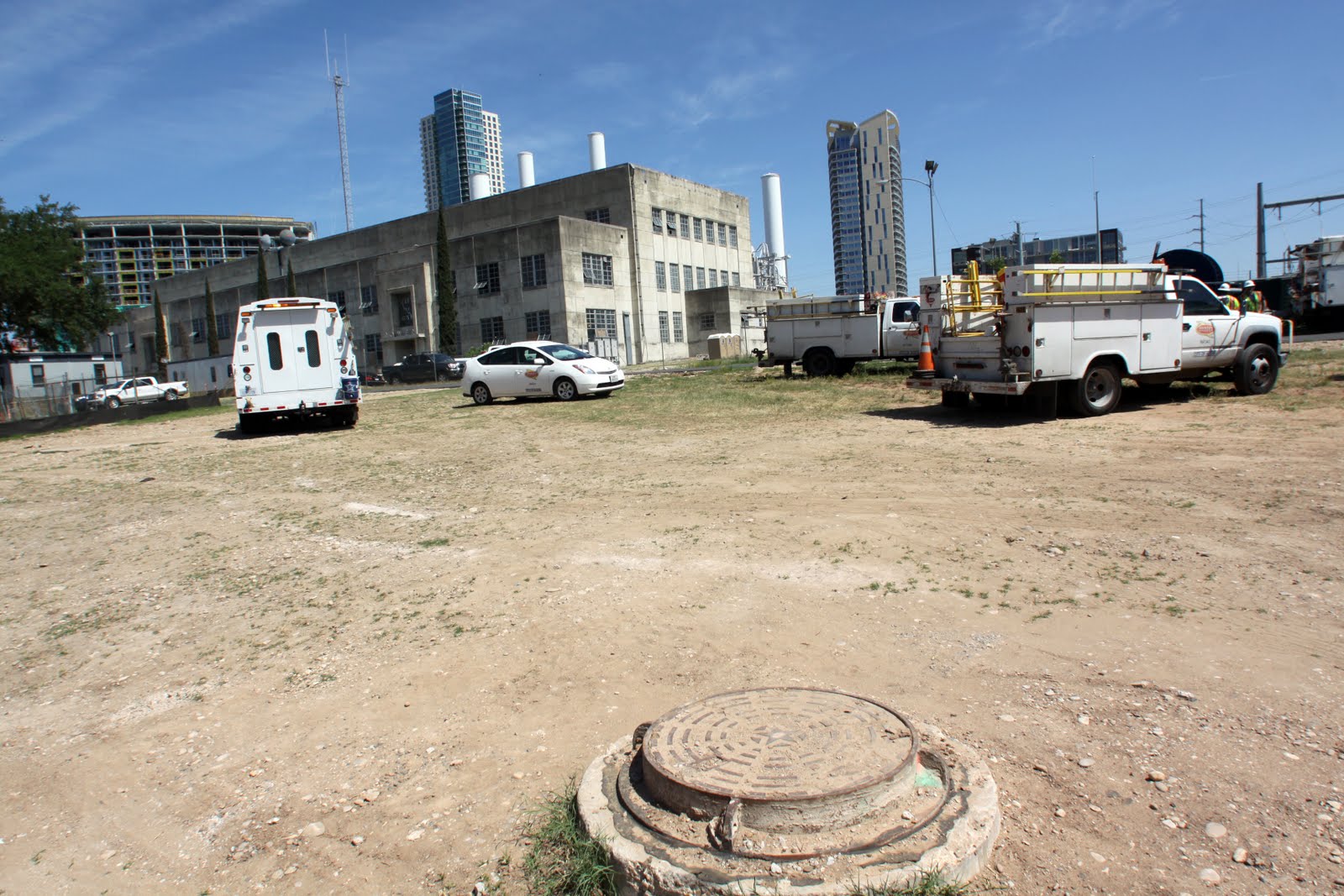
Austin Energy linemen recently rerouted five underground power lines and installed 5,000 linear feet of new cable on the site of the New Central Library near the former Seaholm Power Plant. The linemen completed the work in time to ready the site for a May 30th groundbreaking ceremony for construction of the $90 million, 198,000-square-foot library and also to provide electricity to the former Seaholm Intake Facility across the street, which will be reused for a public purpose on the shores of Lady Bird Lake.

 The New Central Library site is between the former Seaholm Power Plant and former Green Water Treatment Plant, scheduled for redevelopment.

 Austin Energy linemen use reels to install new cable as well as take out old cable that is being replaced. The reels can each hold 1,200 linear feet of cable.

Austin Energy linemen pull out old cable from underground that will no longer be used, because new lines had to be reconfigured as part of the New Central Library site construction.


  Crew members worked in underground vaults to install equipment necessary to power-up the new library construction site. Much of the downtown power grid is underground to increase reliability and aesthetics.

Crew members prepare to begin installing power lines in an underground vault.

 The linemen rerouted five power circuits underground to ready the site for construction of the New Central Library.


Thursday, April 25, 2013

Austin Area Science Fair Students Advance to International Competition

Six science projects involving 9 students from Austin area schools and one from Houston (member of an Austin team) have advanced to the Intel International Science and Engineering Fair to be held May 12-17 in Phoenix, Arizona. This is the annual super bowl of science competition involving some 1,500 of the brightest students from around the world (http://www.societyforscience.org/isef/).

The students below earned their spots at the International fair by advancing from the Austin Energy Regional Science Fair and the ExxonMobil Texas Science and Engineering Fair (http://emtsef.utsa.edu/). Congratulations to these excellent students and their schools for this tremendous achievement.

Meet the students and their projects:


Casey Hicks and Leah Powers (Seniors) – Vista Ridge High School, Cedar Park
Application of T4 Bacteriophages in Real-Life

Summary: Many disease-causing bacteria have become antibiotic resistant, meaning that traditional anti-biotics such as penicillin are less effective. These students demonstrate the use of a bacteria’s natural enemy (a virus) to kill the bacteria instead of antibiotic drugs. 


Alex Crisara (Senior) and Alexander Jahan Rabii (Junior) – Anderson High School, Austin
Efficient Algae-Based Life Support for Long Duration Spaceflight

Summary: Current water and oxygen storage techniques play a huge role in limiting the ability to stay in space for long periods because of their weight and limiting supplies. These students developed a system using algae (comparatively inexpensive) to extend astronauts' time in space by recycling water (for reuse) and producing oxygen in the process.


Jessica Wang, Lily Xu (Juniors- Liberal Arts and Science Academy, Austin) and 
Susan Xu (Junior- Kingwood High, Houston not pictured)
The Connectivity of Sequential Formal Languages with Applications to Genomic Sequences

Summary: Cystic fibrosis is a deadly genetic disease. Current medicine can determine if a patient has the gene but cannot accurately predict if the patient will actually develop the disease. These students created a new mathematical formula for evaluating genes that enables scientists to more accurately predict the probability that a patient who carries the cystic fibrosis gene will actually get the disease.


Vanna Hovanky (Junior) – Bowie High School, Austin
Bacterial β-galactosidase Enzyme-Prodrug Therapy: A New Approach Against Colon Cancer 

Summary: Vanna developed a way to transform harmless bacteria (normally already found in the colon) into a colon cancer-fighting mechanism. The bacteria basically converts a nontoxic drug into a cancer-fighting drug within the colon itself.


Advaith Anand (Junior), Lasa High School, Austin 
Natural Gas Separation Using Thermally Rearranged Polymers - Characterizing Morphological Changes of HAB-6FDA Polyimide Structures

Summary: When natural gas comes out of the ground, it is not in a readily usable form. It must be separated from all of the other liquids and gases (including CO2) before it can be used. This is currently an expensive and relatively inefficient process. Advaith proposes the use of a new material and inventive process that will separate the gas in a more cost effective and efficient manner, thereby reducing production costs and increasing efficiency.


London Bolsius (Sophmore) – Round Rock High School, Round Rock
3D Scanner

Summary: 3D scanners can scan real-world objects (such as a machine part) and import that object into a computer as a 3D object that can then be manipulated on a computer. 3D scanners currently exist but are prohibitively expensive. This student has created a highly accurate 3D scanner that uses “off the shelf” components and software for around $300.

Tuesday, April 23, 2013

Austin Energy To Offer New Thermostat Program

Austin Energy is launching a new voluntary energy management program for residential customers who use WiFi thermostats to control their cooling and heating systems. Qualifying thermostats for the program are Nest, ecobee and Filtrete, which are available through local home improvement  stores or through heating and air conditioning companies. Once a qualifying thermostat has been purchased and installed, a customer can enroll in the Austin Energy Power Partner Program through the respective web site of their thermostat company. Austin Energy provides an $85 rebate for each qualifying installed thermostat.

For the incentive, customers agree to allow Austin Energy to access their thermostats over the internet and briefly modify temperature settings incrementally by up to four degrees over a maximum of three hours (but generally not more than two hours) when demand for electricity is the highest in Austin and Texas. These energy management efforts have been used an average of about 15 days over the summer between 4 and 6 p.m. and only on weekdays.

WiFi thermostats can help customers reduce their annual air conditioning and electric heating costs by up to 20 percent because they allow the customer to manage the comfort of their home or apartment remotely via smart phones or computers. For additional information call Austin Energy at 512-482-5346. 

(This thermostat program has been in the pilot stage for several months and is scheduled for City Council approval this Thursday, April 25.)

Monday, December 17, 2012

Water Treatment Plant #4 Substation To Be Energized

Austin Energy is working to energize by the end of January the Bullick Hollow Substation to help power the construction and later the operation of the Austin Water Utility's Water Treatment Plant #4 under development near RM 620 and Bullick Hollow Road. 

The substation has two large transformers dedicated solely for use by the treatment plant, and it can be expanded with two additional transformers as the needs of the plant grow. Austin Water is among Austin Energy's largest electric customers because of the Water Utility's need to treat and provide water to an ever-growing metro area.

Photos from the substation construction site:


138 kilovolt (kV) Bullick Hollow Substation for Austin's Water Treatment Plant (WTP) #4


Austin Energy's 50 Mega Volt Amperes (MVA) Station Power Transformer that will be used to step down the 138kV to 12.47kV distribution level voltage to feed WTP#4


Austin Energy's 50MVA Station Power Transformer and the 12.47kV Power Control Room


Austin Energy staff perform a monthly Field Safety Audit


Austin Energy's Substation Construction workers prepare conduit for installation.


Final tightening of conduit feeding the Power Control Room


Installing the conduit on the Power Control Room


Installing conduit on the Power Transformer


Austin Energy's Substation Maintenance personnel verifying nitrogen pressure on the Power Transformer


Austin Energy's Substation Maintenance Power Transformer hot oil processing and vacuum filling


View of the Power Transformer and Power Control Room with the overhead distribution lines that will feed the WTP#4


WTP#4 Construction